XiaoMi-AI文件搜索系统
World File Search Systeminhibiting
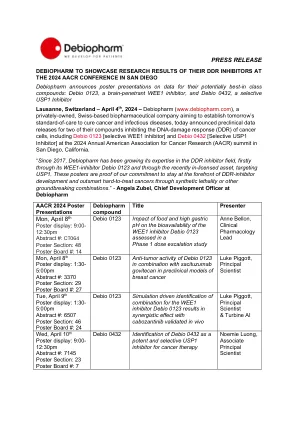
4月8日星期一新闻稿
Lausanne, Switzerland – April 4 th , 2024 – Debiopharm ( www.debiopharm.com ), a privately-owned, Swiss-based biopharmaceutical company aiming to establish tomorrow's standard-of-care to cure cancer and infectious diseases, today announced preclinical data releases for two of their compounds inhibiting the DNA-damage response (DDR) of cancer cells, including Debio 0123 [选择性WEE1抑制剂]和Debio 0432 [选择性USP1抑制剂]在加利福尼亚州圣地亚哥举行的2024年度美国癌症研究协会(AACR)峰会上。
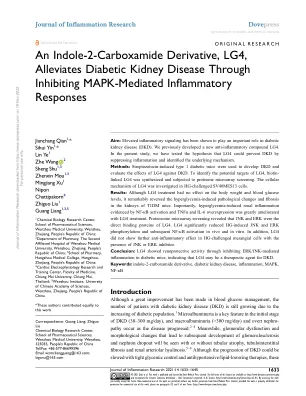
o r i g i n a l r e s e a r c h吲哚-2-羧酰胺衍生物LG4通过抑制MAPK介导的炎症来减轻糖尿病肾脏疾病
AIM:升高的炎症信号传导已显示在糖尿病肾脏疾病(DKD)中起重要作用。我们以前开发了一种新的抗炎化合物LG4。在本研究中,我们检验了以下假设:LG4可以通过抑制炎症并确定基本机制来预防DKD。方法:使用链蛋白酶诱导的1型糖尿病小鼠开发DKD并评估LG4对DKD的影响。为了确定LG4的潜在靶标,合成了与生物素连接的LG4并进行蛋白质组微阵列筛选。在HG挑战的SV40MES13细胞中研究了LG4的细胞机制。结果:尽管LG4治疗对体重和血糖水平没有影响,但它明显逆转了高血糖诱导的T1DM小鼠肾脏的病理变化和纤维化。重要的是,通过LG4处理,通过NF-κB激活和TNFα和IL-6过表达证明了高血糖诱导的肾脏炎症。蛋白体微阵列筛选表明JNK和ERK是LG4的直接结合蛋白。lg4显着降低了HG诱导的JNK和ERK磷酸化以及随后在体内和体外的NF-κB激活。此外,LG4与JNK或ERK抑制剂的存在中没有在HG挑战的中敏细胞中显示出进一步的抗炎作用。结论:LG4通过抑制ERK/JNK介导的糖尿病小鼠的炎症表现出重新保护活性,表明LG4可能是DKD的治疗剂。关键字:吲哚-2-羧酰胺衍生物,糖尿病肾脏疾病,炎症,MAPK,NF-κB
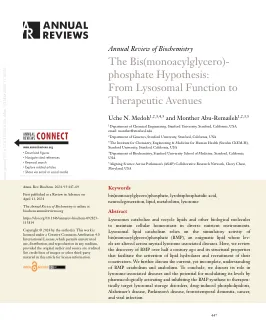
bis(单乙酰甘油) - 磷酸盐假设
溶酶体分解并回收脂质和其他生物分子,以维持各种营养环境中的细胞稳态。溶酶体脂质分解代谢依赖于BIS(Monoacylglycero)磷酸盐(BMP)的刺激活性,这是一种神秘的脂质,其在众多溶酶体相关疾病中都会改变其左旋脂质。在这里,我们回顾了半个世纪前对BMP的发现及其结构特性,可促进脂质水解酶的激活和募集其共激活因子。我们进一步讨论了对BMP分解代谢和合成代谢的当前但不完整的理解。To conclude, we discuss its role in lysosome-associated diseases and the potential for modulating its levels by pharmacologically activating and inhibiting the BMP synthase to therapeu- tically target lysosomal storage disorders, drug-induced phospholipidosis, Alzheimer's disease, Parkinson's disease, frontotemporal dementia, cancer, and viral infection.
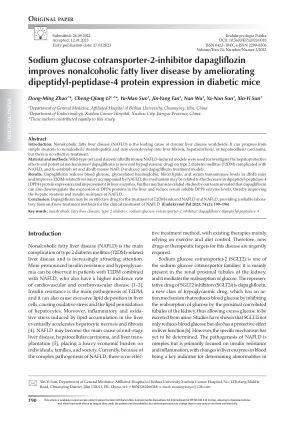
葡萄糖共转运蛋白-2抑制剂Dapagliflozin ...
治疗方法,现有疗法主要依赖于运动和饮食控制。因此,迫切需要对该疾病的新药或治疗靶标。葡萄糖共转运蛋白2(SGLT2)是葡萄糖共转运蛋白家族之一。它主要存在于肾脏的肾近端小管中,并介导葡萄糖的重吸收。The represen- tative drug of SGLT2 inhibitors (SGLT2i) is dapagliflozin, a new class of hypoglycaemic drug, which has an ac- tion mechanism that reduces blood glucose by inhibiting the reabsorption of glucose by the proximal convoluted tubules of the kidney, thus allowing excess glucose to be excreted from urine.研究表明,SGLT2I不仅降低了血糖,而且对肝功能具有保护作用[6]。但是,具体机制尚未确定。NAFLD的发病机理很复杂,但主要集中于胰岛素抵抗和炎症,血液中肝酶的变化是确定

Targeting ERK-MYD88 interaction leads to ERK dysregulation and immunogenic cancer cell death
The quest for targeted therapies is critical in the battle against cancer. The RAS/ MAP kinase pathway is frequently implicated in neoplasia, with ERK playing a crucial role as the most distal kinase in the RAS signaling cascade. Our previous research demonstrated that the interaction between ERK and MYD88, an adaptor protein in innate immunity, is crucial for RAS-dependent transforma- tion and cancer cell survival. In this study, we examine the biological con- sequences of disrupting the ERK-MYD88 interaction through the ERK D-recruitment site (DRS), while preserving ERK ' s kinase activity. Our results indicate that EI-52, a small-molecule benzimidazole targeting ERK-MYD88 interaction induces an HRI-mediated integrated stress response (ISR), resulting in immunogenic apoptosis speci fi c to cancer cells. Additionally, EI-52 exhibits anti-tumor ef fi cacy in patient-derived tumors and induces an anti-tumor T cell response in mice in vivo. These fi ndings suggest that inhibiting the ERK-MYD88 interaction may be a promising therapeutic approach in cancer treatment.
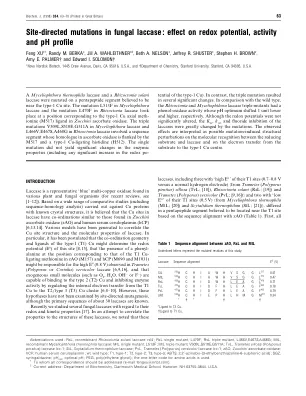
真菌漆中的位置定向突变:对氧化还原电位,活动和pH值的影响
漆酶是在各种植物和真菌生物中发现的代表性的“蓝色”多型氧化酶(有关最近的评论,请参见[1-12])。基于针对具有已知晶体结构的CU蛋白进行的广泛比较研究(包括序列 - 同学分析),据认为,漆酶中的CU位点的协调位点与在西葫芦抗坏血酸抗坏血酸抗坏血酸抗压酸氧化酶(ZAO)和人血清ceruloplasmlasmin(HCP)[6,13,13,13,14]中相似。已经生成了各种模型,以将CU位点结构和漆酶的分子特性相关联。尤其是据推测,1(T1)Cu的协调几何形状和配体可能会确定氧化还原电位(E!)[8,15],在ZAO(M157)和HCP(M690和M1031)中与T1 Cu-ligating蛋氨酸相对应的位置的苯丙氨酸的存在可能是高E的责任! (0.8 V) observed in Trametes ( Polyporus or Coriolus ) ersicolor laccase [6,9,16], and that exogeneous small molecules (such as O # , H # O, OH − or F − ) are capable of binding to the type 2 (T2) Cu and inhibiting enzyme activity by regulating the internal electron transfer from the T1 Cu to the T2 } type 3 (T3)Cu簇[6,8-10]。 然而,尽管已知大约30个laccase的主要序列,但尚未通过定点诱变来研究这些假设。 最近,我们研究了几个真菌lac酶关于它们的氧化还原和动力学特性[17]。 试图将属性与这些漆酶的结构相关联,我们注意到这些[8,15],在ZAO(M157)和HCP(M690和M1031)中与T1 Cu-ligating蛋氨酸相对应的位置的苯丙氨酸的存在可能是高E的责任!(0.8 V) observed in Trametes ( Polyporus or Coriolus ) ersicolor laccase [6,9,16], and that exogeneous small molecules (such as O # , H # O, OH − or F − ) are capable of binding to the type 2 (T2) Cu and inhibiting enzyme activity by regulating the internal electron transfer from the T1 Cu to the T2 } type 3 (T3)Cu簇[6,8-10]。然而,尽管已知大约30个laccase的主要序列,但尚未通过定点诱变来研究这些假设。最近,我们研究了几个真菌lac酶关于它们的氧化还原和动力学特性[17]。试图将属性与这些漆酶的结构相关联,我们注意到这些