
XiaoMi-AI文件搜索系统
World File Search SystemCrossroads
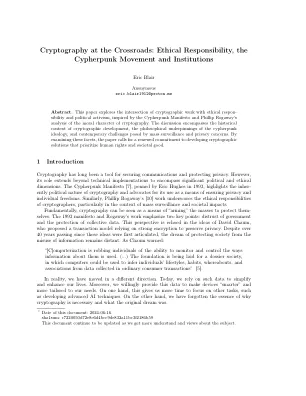
十字路口的密码学:道德责任,Cypherpunk运动和机构
密码学长期以来一直是确保通信和保护隐私的工具。但是,其作用超出了技术实施,以涵盖重要的政治和道德方面。由埃里克·休斯(Eric Hughes)于1993年撰写的Cypherpunk宣言[7],强调了加密和拥护者的继承性政治本质,以此作为确保隐私和个人自由的一种手段。同样,菲利普·罗加威(Phillip Rogaway)的[10]工作强调了密码学家的道德责任,尤其是在大规模监视和社会影响的背景下。从根本上讲,密码学可以看作是“武装”群众保护自己的群众的一种手段。1993年的宣言和罗加威的作品强调了两个要点:不信任政府和保护集体数据。这种观点在戴维·乔姆(David Chaum)的思想中得到了回应,他提出了一个依靠强大加密来保护隐私的交易模型。尽管这些想法首次阐明了40多年,但保护社会免受信息滥用的梦想仍然很遥远。Chaum警告:
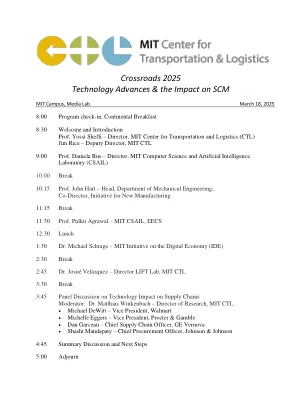
Crossroads 2025技术进步和对SCM MIT校园的影响
Crossroads 2025 Technology Advances & the Impact on SCM MIT Campus, Media Lab March 18, 2025 8:00 Program check-in, Continental Breakfast 8:30 Welcome and Introduction Prof. Yossi Sheffi – Director, MIT Center for Transportation and Logistics (CTL) Jim Rice – Deputy Director, MIT CTL 9:00 Prof. Daniela Rus – Director, MIT Computer Science and Artificial Intelligence Laboratory ( CSAIL) 10:00休息10:15约翰·哈特教授 - 机械工程系负责人;联合导演,新制造计划11:15休息11:30 Pulkit Agrawal教授 - MIT CSAIL,EECS,EECS 12:30午餐1:30 Michael Schrage博士 - MIT数字经济倡议(IDE)2:30 Break 2:45 Matthias Winkenbach - 研究主管,麻省理工学院CTL•迈克尔·德威特(Michael Dewitt) - 沃尔玛副总裁•米歇尔·艾格斯(Michelle Eggers) - 宝洁副总裁•丹·加考

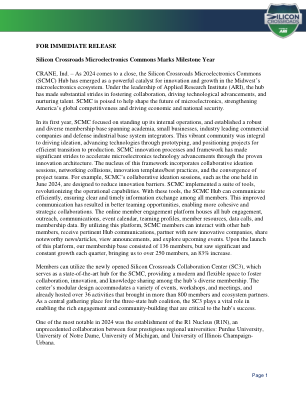
Silicon Crossroads Microelectronics Commons
FOR IMMEDIATE RELEASE Silicon Crossroads Microelectronics Commons Marks Milestone Year CRANE, Ind. – As 2024 comes to a close, the Silicon Crossroads Microelectronics Commons (SCMC) Hub has emerged as a powerful catalyst for innovation and growth in the Midwest's microelectronics ecosystem. Under the leadership of Applied Research Institute (ARI), the hub has made substantial strides in fostering collaboration, driving technological advancements, and nurturing talent. SCMC is poised to help shape the future of microelectronics, strengthening America's global competitiveness and driving economic and national security. In its first year, SCMC focused on standing up its internal operations, and established a robust and diverse membership base spanning academia, small businesses, industry leading commercial companies and defense industrial base system integrators. This vibrant community was integral to driving ideation, advancing technologies through prototyping, and positioning projects for efficient transition to production. SCMC innovation processes and framework has made significant strides to accelerate microelectronics technology advancements through the proven innovation architecture. The nucleus of this framework incorporates collaborative ideation sessions, networking collisions, innovation templates/best practices, and the convergence of project teams. For example, SCMC's collaborative ideation sessions, such as the one held in June 2024, are designed to reduce innovation barriers. SCMC implemented a suite of tools, revolutionizing the operational capabilities. With these tools, the SCMC Hub can communicate efficiently, ensuring clear and timely information exchange among all members. This improved communication has resulted in better teaming opportunities, enabling more cohesive and strategic collaborations. The online member engagement platform houses all hub engagement, outreach, communications, event calendar, teaming profiles, member resources, data calls, and membership data. By utilizing this platform, SCMC members can interact with other hub members, receive pertinent Hub communications, partner with new innovative companies, share noteworthy news/articles, view announcements, and explore upcoming events. Upon the launch of this platform, our membership base consisted of 136 members, but saw significant and constant growth each quarter, bringing us to over 250 members, an 83% increase. Members can utilize the newly opened Silicon Crossroads Collaboration Center (SC3), which serves as a state-of-the-art hub for the SCMC, providing a modern and flexible space to foster collaboration, innovation, and knowledge sharing among the hub's diverse membership. The center's modular design accommodates a variety of events, workshops, and meetings, and already hosted over 36 activities that brought in more than 800 members and ecosystem partners. As a central gathering place for the three-state hub coalition, the SC3 plays a vital role in enabling the rich engagement and community-building that are critical to the hub's success. One of the most notable in 2024 was the establishment of the R1 Nucleus (R1N), an unprecedented collaboration between four prestigious regional universities: Purdue University, University of Notre Dame, University of Michigan, and University of Illinois Champaign- Urbana.

人工智能处于自然语言处理和神经科学的交叉点
HAL 是一个多学科开放存取档案库,用于存放和传播科学研究文献,无论这些文献是否已出版。这些文献可能来自法国或国外的教学和研究机构,也可能来自公共或私人研究中心。


创新十字路口计划简介
Brendan Abolins – 伊士曼化学公司 Coleman Adams – 清洁能源风险投资集团 Jason Blumberg – Earth Foundry Brandon Bruce – Market Square Ventures John Bruck – Market Square Ventures Doug Buerkle – LTM Ventures Lindsey Cox – Launch Tennessee Eric Dobson – Community Equity Partners Jonathan Goldman – 佐治亚理工学院 VentureLab Alison Gotkin – 雷神技术研究中心 Maha Krishnamurthy – 田纳西大学研究基金会 Paul Leggett – Mithril Capital Management Vig Sherrill – General Graphene Lilly Tench – Spark Innovation Center Grady Vanderhoofven – Three Roots Capital Peter Winter – In-Q-Tel Johanna Wolfson – Prime Impact Fund

现在的紧迫性:十字路口的援助
根据本许可的条款,您可以为非商业目的复制,重新分配和调整工作,前提是适当地引用了工作,如下所示。在任何使用这项工作时,都不应该建议联合国艾滋病规划署认可任何特定的组织,产品或服务。不允许使用UNAIDS徽标。如果您适应了工作,则必须根据相同或同等的创意共享许可证许可您的工作。如果您创建了这项工作的翻译,则应添加以下免责声明以及建议的引用:“此翻译不是由Unaids创建的。unaids对本翻译的内容或准确性不承担任何责任。原始英语版应为绑定和真实版。”
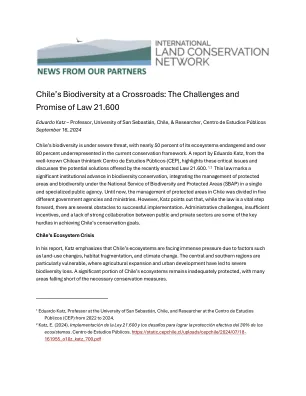
智利在十字路口的生物多样性
Eduardo Katz - 智利圣塞巴斯蒂大学教授,智利和研究人员,埃斯图迪奥斯·普布利科斯(Centro de EstudiosPúblicos)2024年9月16日,智利的生物多样性受到严重威胁,其生态系统中的近50%濒临灭绝,在当前的保护框架中属于80%以上的生态系统。Eduardo Katz的一份报告,来自著名的智利智慧中心Públicos(CEP),重点介绍了这些关键问题,并讨论了最近颁布的法律21.600提供的潜在解决方案。1,2这项法律标志着生物多样性保护方面的重要机构进步,将保护区和生物多样性的管理整合在一个生物多样性和保护区(SBAP)的国家中,并在一个单一的专业公共机构中融合在一起。到目前为止,智利保护区的管理在五个不同的政府机构和政府部门中被划分。但是,卡茨指出,尽管法律是向前迈出的至关重要的一步,但成功实施的障碍存在几个障碍。行政挑战,不足的激励措施以及公共部门和私营部门之间缺乏强大的合作是实现智利保护目标的一些关键障碍。

人类在十字路口:自主武器系统和法规的挑战
媒体所有者,出版商和编辑:联邦欧洲和国际事务部裁军,军备控制和非扩展少数派兹普茨8,1010 Vienna +43(0)50 11 50 50-0 BMEIA.GV.GV.AT作者:裁定,军备控制和非预订局的武器,军备控制和非预订部:欧洲和国际事务部: