
XiaoMi-AI文件搜索系统
World File Search SystemPSTI
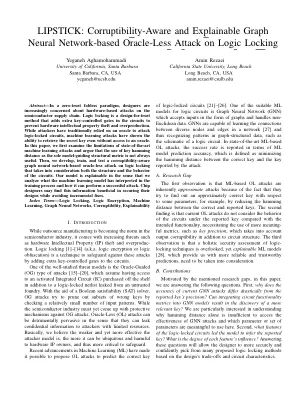
LIPSTICK:基于可腐败感知和可解释图神经网络的无 Oracle 逻辑锁定攻击
摘要 — 在零信任无晶圆厂范式中,设计人员越来越担心基于硬件的半导体供应链攻击。逻辑锁定是一种信任设计方法,它在电路中添加额外的密钥控制门,以防止硬件知识产权被盗和生产过剩。虽然攻击者传统上依靠预言机来攻击逻辑锁定电路,但机器学习攻击已经显示出即使没有预言机也能检索密钥的能力。在本文中,我们首先研究了最先进的机器学习攻击的局限性,并认为使用密钥汉明距离作为唯一的模型指导结构度量并不总是有用的。然后,我们开发、训练和测试一种基于可破坏性感知图神经网络的逻辑锁定无预言机攻击,该攻击同时考虑了电路的结构和行为。我们的模型是可以解释的,因为我们分析了机器学习模型在训练过程中解释了什么以及它如何进行成功的攻击。芯片设计人员可能会发现这些信息有助于保护他们的设计,同时避免增量修复。索引术语 — 逻辑锁定、逻辑加密、机器学习、图神经网络、可破坏性、可解释性
PPSTI Strategic Plan (2016-2025)
According to the blueprint proposed in “2011 Honolulu Declaration”, “2012 Vladivostok Declaration”, “2013 Bali Declaration”, and “2014 Beijing Declaration”, the innovative growth strategy is closely related to regional cooperation, human resource exchange, and infrastructure development. APEC leaders committed to fostering a pragmatic, efficient and vigorous partnership on STI. In 2017, Leaders' Declaration emphasized the importance of innovation, science and technology as key drivers for economic growth and international trade and investment in the APEC region. Furthermore, APEC Putrajaya Vision 2040 which launched in 2020 indicates the APEC is in position to further advance the Bogor Goals. Guided by the goal of building an open, dynamic, resilient and peaceful Asia-Pacific community by 2040, APEC members will explore new frontiers for cooperation in the priority areas of trade and investment, innovation and digitalization, and strong, balanced, secure, sustainable and inclusive growth. The Vision states that APEC will foster an enabling environment that is market-driven and supported by digital economy and innovation, and pursue structural reforms and sound economic policies to promote innovation as well as improve productivity and dynamism, which will empower all the people and businesses in the region to participate and grow in an interconnected global economy. Later on in 2021, APEC leaders adopted the Aotearoa Plan of Action as a plan for implementing the Putrajaya Vision 2040.